Seminole County FL provides information on public records, including inmate rosters, property deeds, and booking records. Users can review current inmate listings and recent bookings. Available records may also include release history and case details. The portal helps residents understand public record information and locate relevant records.
Looking for arrest records, active warrants, or criminal history? The clerk’s portal returns full arrest logs, bench warrant status, and DUI filings, while the court section offers case searches, docket schedules, and civil or family filings. Need birth, death, or marriage documents? Vital records are searchable alongside property deeds, tax liens, and GIS maps. Reach the office during business hours for assistance or call the listed number for direct support.
How to Search Seminole County FL
Seminole County FL record searches cover court filings, inmate listings, deeds, birth and death records, property data, and other public records held across county and state offices. A search helps locate a specific record, but the agency and record type determine what the result can prove. Check names, dates, case numbers, parcel identifiers, and record status against the source before relying on them. Use the official portal and steps below to reach the right office and the correct copy request.
Official Search Portal: https://www.seminoleclerk.org
Steps to Search
- Open the official portal and choose the category that matches your record.
- Enter the most complete identifier shown by the search form, such as a legal name, case number, parcel number, or address.
- Open the matching result and compare the party, address, date, and record type with your own details.
- Read the status and date fields, then check any official instructions for viewing, copying, certifying, or paying for a record.
- If the result is missing or unclear, contact the Seminole County Clerk using the details at the end of this page.
The supplied source confirms the office address, phone number, hours, and portal. It does not state fees, request deadlines, processing times, or every menu label, so check the live page or ask the office before filing.
Record Sources and Office Boundaries
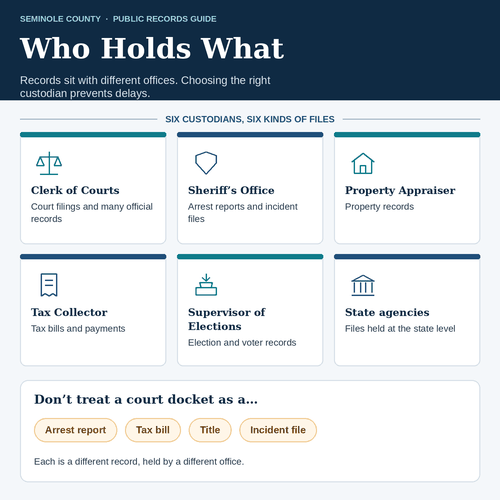
Many Seminole County records sit with different offices. The Clerk of Courts handles court filings and many official records, while the Sheriff’s Office, Property Appraiser, Tax Collector, Supervisor of Elections, and state agencies hold other files. Choosing the right custodian prevents delays and avoids treating a court docket as an arrest report, tax bill, title, or incident file.
Clerk of Courts and criminal case levels
The Seminole County Clerk of Courts records civil, family, probate, traffic, and criminal filings handled by the courts. Read the court name on a criminal filing: Florida circuit courts normally handle felony cases, while county courts handle misdemeanor cases. A DUI case may appear in either system because the charge and prior record can affect its classification.
Other offices with separate records
The word “clerk” does not cover every public file. An inmate booking belongs to the jail and Sheriff’s Office, a parcel value belongs to the Property Appraiser, a tax bill belongs to the Tax Collector, and a corporate filing belongs to the Florida Division of Corporations.
| Record Need | Office That Holds the Record |
|---|---|
| Court filings, marriage records, divorce decrees, deeds, and official records | Seminole County Clerk of Courts |
| Inmate roster, bookings, releases, police reports, and active warrants | Seminole County Sheriff’s Office |
| Property assessments, ownership data, parcel details, and appraisal maps | Seminole County Property Appraiser |
| Tax bills, payments, receipts, and tax lien records | Seminole County Tax Collector |
| Birth and death certificates | Florida Department of Health or the local registration office holding the event |
| Business registration, assumed names, and UCC filings | Florida Division of Corporations |
| Vehicle titles, registrations, and statewide crash data | Florida Highway Safety and Multimodal Network or the reporting agency |
| Voter registration, election records, polling places, and precinct maps | Seminole County Supervisor of Elections |
| Unclaimed funds and property | Florida Department of Financial Services |
Inmate, Arrest, and Warrant Records
The supplied official path includes current inmate listings, recent bookings, and release history. These records answer custody questions, but they do not decide whether a person committed the alleged offense.
Current inmate roster and population
A current inmate roster is a point-in-time list of people held by the jail. It can change during the day, so a name on one list does not prove where the person is later. A roster count is not a full statistical report of jail capacity, length of stay, or monthly totals.
Recent bookings, mugshots, and releases
A booking records a jail event. A mugshot, when shown, is tied to that booking and is not proof of conviction. A release entry records that the jail released the person, but it does not erase the court case, bond conditions, or later orders. Compare the booking date, release date, and case number before drawing a conclusion.
Active warrants and bench warrants
Use the Sheriff’s official warrant search for active wanted-person listings. Verify the case number, charge, and status with the agency before acting. A bench warrant is issued by a court, often after a failure to appear, so the related court docket may show its status. One agency’s list may not cover warrants held elsewhere.
Criminal history, felony records, and DUI cases
An arrest is not a conviction. A case can end in dismissal, adjudication, plea, or another outcome, and one case index does not create a full criminal history report. A formal background check must follow the identity, consent, and access rules of an approved service. The Clerk can supply court records; it does not replace a criminal-history report.
| Record Type | What It Shows | What It Does Not Prove |
|---|---|---|
| Booking | The jail recorded a detention event | A conviction or the outcome of the case |
| Mugshot | An image connected with a booking | That the person was found guilty |
| Release | The jail released the person on a stated date | That every court or bond condition ended |
| Arrest | Officers took the person into custody | That the alleged charge was proven |
| Warrant listing | A law enforcement agency lists an active warrant | Current status without agency confirmation |
| Court disposition | The court entered a case outcome | Every arrest or event outside that file |
Court Records and Hearing Searches
Court records cover filed cases, parties, claims, orders, and hearing events. Search by the exact legal name shown on the case or by the court-assigned case number.
Search by name or case number
A case number usually gives a faster match than a common name because it points to one court file. Check that the result names the intended parties and appears under the expected court and case type. A defendant’s legal name may differ from a nickname or everyday spelling.
Dockets, schedules, and hearings
A docket lists filings and case events. A schedule may show upcoming appearances, but dates, times, courtrooms, and remote appearance methods can change. Confirm the event with the court record before making plans. Request a certified copy when a recipient requires an authenticated court record.
Court case types
Different case types answer different questions. A criminal file follows charges and court actions; a civil file follows claims, defenses, and judgments; a family file covers divorce, custody, or support orders; a probate file covers estate filings and court orders; and a traffic file covers citations and their court status.
| Case Type | Typical Record | Key Distinction |
|---|---|---|
| Criminal | Charges, filings, status, orders, and hearings | A court case is not a complete arrest or criminal-history report |
| Civil | Claims, defenses, judgments, and case filings | A judgment does not describe every financial obligation |
| Family | Divorce, custody, support, and related orders | Access to certain sensitive filings can depend on court rules |
| Probate and estate | Petitions, orders, status, and estate proceedings | A probate file does not guarantee that a private original will is available |
| Traffic | Citations, pleas, hearings, and court disposition | A crash report remains a separate agency record |
Birth, Death, Marriage, and Genealogy Records
Birth and death certificates follow state civil-status rules. Recent certificates can involve eligibility and identity checks, and rules may differ for older records and immediate-family requests. Use the Florida Department of Health or the local registration office that holds the event; a court search does not replace the certificate process.
Marriage licenses and divorce decrees
The Clerk issues marriage licenses and records completed marriage documents. A license permits a marriage; a certificate records the completed marriage after the returned license is filed. Divorce decrees come from the court file, so search the family case by party name or case number.
Genealogy and historical obituaries
Genealogy work often combines church registers, census records and inmate search, newspapers, obituaries, cemetery lists, and court files. An obituary can preserve family details, but it is not legal proof of birth, death, or marriage. Use a certificate or decree when an agency asks for a legal record.
| Record | Official Source | Practical Point |
|---|---|---|
| Birth certificate | Florida Department of Health or local registration office | Recent copies can require eligibility and identity checks |
| Death certificate | Florida Department of Health or local registration office | An obituary is not a certified death certificate |
| Marriage license or certificate | Seminole County Clerk | The license and completed certificate serve different purposes |
| Divorce decree | Seminole County Clerk court records | Search by party name or the family case number |
Property, Tax, Deeds, and GIS Maps
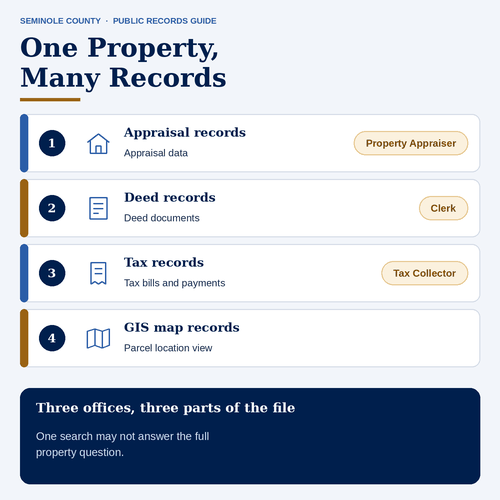
Property searches divide into appraisal, deed, tax, and map records. The Property Appraiser, Clerk, and Tax Collector each hold a different part of the file, so one search may not answer the full property question.
Property search by owner or address
Start with an address, legal description, or parcel number in the Property Appraiser’s official search. An owner name may differ from the person shown on a deed because of conveyances, liens, co-ownership, or name formats. Confirm the parcel on a map before treating a match as the right property.
Deeds, titles, and parcel maps
The Clerk’s deed records show transfers and recording details. A deed is a recorded instrument; title is the legal status of ownership and may be affected by unrecorded interests, liens, or court decisions. A recorded deed alone does not settle a title dispute. Property Appraiser GIS maps provide parcel boundaries but should be checked for their map date and source layer.
Tax records and tax liens
The Tax Collector handles tax bills, payment records, and tax lien records. Property Appraiser GIS maps place parcel boundaries over street data, while the Supervisor of Elections publishes voting district and precinct maps. Compare map layers and dates because boundaries and ownership can change.
| Search Need | Record Holder | Main Search Fields |
|---|---|---|
| Current parcel and assessed value | Property Appraiser | Owner, address, parcel number, legal description |
| Recorded sale or transfer | County Clerk | Grantors, grantees, parcel, date, instrument |
| Parcel boundary | Property Appraiser GIS | Address, parcel number, map layer |
| Tax bill or payment receipt | Tax Collector | Parcel number, owner, account, year |
| Tax lien | Tax Collector and related title records | Parcel, owner, lien year, recorded document |
| Precinct or voting district | Supervisor of Elections | Address, precinct, district, map date |
Police, Vehicle, and Accident Records
Police reports describe incidents from the agency that investigated them. A county case may involve the Sheriff’s Office, a municipal police department, or another agency with jurisdiction. Identify the agency named on the report before asking for a copy.
Police reports and incident blotter
An incident blotter lists reported events and may omit details protected from release. A case number in a report can help locate later court filings, but the report and court case serve different purposes.
Traffic violations
A traffic violation moves through police and court systems. The officer’s report describes the event, while the court file shows charges, pleas, and disposition. A ticket alone does not show the final outcome.
Accident and crash reports
A crash report can include diagrams, vehicle descriptions, and the officer’s findings. It does not decide legal fault, insurance coverage, or damages. Request the report from the investigating agency; statewide crash data may come from the Florida Highway Safety and Multimodal Network.
License plate, VIN, registration, and title
Vehicle registration and title records come from the Florida Highway Safety and Multimodal Network, not the county Clerk. Registration shows the state’s record for a registered vehicle, while a title documents ownership history. Plate and VIN requests may be limited by the purpose and rules of the specific search.
| Record | Official Source | What It Shows |
|---|---|---|
| Police report | Investigating law enforcement agency | The officer’s account and incident details |
| Incident blotter | Law enforcement agency | A reported event, subject to release rules |
| Traffic citation | Court handling the traffic case | Charges and case disposition, not the full police file |
| Crash report | Investigating agency or FLHSMV | Crash details, not a ruling on fault or damages |
| Vehicle registration or title | FLHSMV | Registration status or documented ownership history |
Business and Public Contact Searches
The Clerk is not a general resident directory. The supplied materials do not state that the portal offers a reverse-phone lookup, private resident search, or personal contact file.
Business entities, assumed names, and UCC filings
Business registration, assumed names, and UCC records are handled by the Florida Division of Corporations. Entity registration shows that a business exists under a name; it does not prove that the business is active, licensed, or free of claims. An assumed name filing identifies a trade name and does not create a separate corporation.
Public contact details and reverse-phone searches
Use official business and agency directories to reach a public office. A home address, mobile number, and family details may be restricted by privacy rules, and a third-party data broker’s result may be stale or tied to an old number. To verify a business number, match it with the organization’s official website and published county records.
| Search Goal | Proper Official Route |
|---|---|
| Find a registered business | Florida Division of Corporations entity search |
| Check an assumed name | Florida Division of Corporations assumed-name records |
| Review a UCC filing | Florida Division of Corporations UCC records |
| Reach a county office | The office’s published website and contact directory |
| Verify a business phone number | The business’s official website and county business records |
| Locate a private resident | Use a lawful, consent-based method rather than a data broker listing |
Florida Public Records and Department Requests
Florida’s Public Records Law is Chapter 119 of the Florida Statutes. FOIA applies to federal agencies; Florida agencies use a public records request under state law. A records search finds a listed item, while a records request asks an agency for material that may not appear in an online index.
Public records request procedure
Start with the agency that created the record. Ask for a specific document type, date range, case number, parcel number, or event date. The agency may provide a form, request identification, or set a fee under its published rules.
Record limits and legal exceptions
Not every file or part of a file is open. Chapter 119 and other state or federal rules can restrict police, personal, personnel, investigative, and other records and court records. The agency’s written response should state any claimed exception and the available review path.
Copies, certification, and payment
Search results, uncertified printouts, and certified copies are different products. A certified copy carries the issuing office’s authentication. Use it when a lender, court, agency, or other recipient requires certification. The Clerk’s fee schedule and request page control the amount and payment method.
- Identify the custodian and the exact document needed.
- Check the available search before submitting a separate request.
- Use the agency’s official request form or published contact route.
- Provide the required identifiers, date range, and record scope.
- Review the response, fee basis, copy type, and certification requirements before payment.
County Government, Courts, and Elections
County records reflect separate offices and boards. Knowing the office behind a document helps you select the right record and request path.
County Clerk and County Judges
The Clerk of Courts maintains case records, while judges rule on cases and issue orders. A judge’s decision appears in the case file, and the Clerk supplies the filed or certified version. The supplied source lists the Clerk as the central records contact for the office at 101 Bush Blvd.
Auditor and tax records
Tax bills, payment receipts, and tax lien searches belong with the Seminole County Tax Collector. A request for a “county auditor” record may refer to an audit document rather than a taxpayer account, so name the document and fiscal year before contacting an office. A clerk record search does not replace a tax account.
Sheriff’s Office
The Sheriff’s Office operates the county jail and handles police matters within its jurisdiction. Jail rosters, booking and release records, incident reports, and warrant listings should come from that office. The Clerk can supply related court filings but cannot replace custody data.
County Commissioners
The County Commission sets county policy, budgets, contracts, and public works policy. Agendas, minutes, ordinances, and contract records belong to the commission process. Florida’s Sunshine Law in Chapter 189 governs records of public-body meetings, and commission records should go to the responsible county office rather than a court index.
Elections and voter records
The Supervisor of Elections handles election administration, voter registration systems, polling places, and precinct maps. You can check your own registration and polling details through the official election lookup. Other voters’ registration files carry privacy limits and are not a general browsing service.
Unclaimed Funds and Property
Unclaimed funds and property are handled by the Florida Department of Financial Services, not the Seminole County Clerk. The state search covers assets such as uncashed checks, wages, insurance payments, and items held in safe-deposit boxes.
Search for unclaimed property
Search with the owner’s legal name and compare possible matches by name, last-known address, and asset type. A match does not transfer ownership to the searcher; it starts a claim with the state.
Claim unclaimed funds
The owner or an authorized claimant must follow the state’s claim instructions and provide proof of identity and ownership. Keep the search result and claim reference with your records. Do not pay a third-party recovery service based only on a list of names unless you have checked its credentials and fees.
| Possible Match | Claim Step | Key Check |
|---|---|---|
| Uncashed check or wage payment | Follow the state claim instructions for the listed asset | Identity and proof that the claimant owns the payment |
| Insurance payment | Use the state claim process for the listed policy payment | Policyholder status and claim reference |
| Safe-deposit box contents | Follow the instructions for the listed financial institution holding | Ownership documents and chain of ownership |
Contact Details
Public records can be mistaken for stronger proof than they are. Before using a result for a legal, financial, employment, or personal decision, check the source, identifiers, date, status, and copy type.
Use the following details for Seminole County Clerk record searches or help with a request.
Location: 101 Bush Blvd, Sanford, FL 32773
Contact Number: (407) 665-4300
Office Hours: Mon-Fri: 8:00 AM – 4:30 PM
Official Website Search Portal: https://www.seminoleclerk.org
Call during posted office hours to confirm the correct record type, required form, identification rules, copy fees, and accepted payment method. Check the official site before traveling because county holidays can affect office hours.
Frequently Asked Questions
Seminole County FL offers many public services, from court filings to property records. Residents and researchers use the county’s online portal and local offices to get official documents quickly. Knowing the correct address, phone number, and office hours saves time and avoids extra trips. The answers below give clear steps for common requests.
How can I search public records in Seminole County FL?
Start at the official records portal at seminoleclerk.org. Choose the record type—court case, deed, or vital record. Enter the name, case number, or parcel ID in the search boxes. Review the preview to verify details. If the document matches, download the PDF for free or click the eCertified button to purchase a certified copy. The site updates daily, so the latest filings appear within minutes of recording.
Which Office Handles Property Deed Requests?
The Clerk of the Circuit Court and Comptroller processes deed requests at that address. Call (407) 665-4300 during the Monday‑Friday schedule of 8:00 AM to 4:30 PM. Bring a photo ID and the book and page numbers if you have them. The staff will retrieve the record, print an uncertained copy at no charge, or sell a certified copy for a small fee. You can also request the deed online before visiting.
Where can I find marriage license forms in Seminole County FL?
Visit the clerk’s website and click the marriage license link. The online form lets you fill out required fields, then print the completed page. Bring the printed form, two forms of identification, and the $86 fee to the clerk’s office at 101 Bush Blvd. The staff will review the information, record the license, and issue it the same day if all requirements are met.
How do I obtain a certified copy of a court record during office hours?
Go to the clerk’s office between 8:00 AM and 4:30 PM. Tell the clerk the record type and provide the case number or book and page details. Pay the per‑page certification fee. The clerk will print the certified copy and stamp it with the official seal. You can also order the same document online by selecting the eCertified option and paying with a credit card.
How to Find Inmate Records in Seminole County?
Open the inmate search page on seminoleclerk.org. Choose the “Inmate Lookup” tab. Enter the inmate’s first and last name or booking number. Filter results by date of birth if needed. Review the list to find the correct individual, then click the record to see charges, bond amount, and upcoming court dates. The portal updates daily, so the latest information appears quickly.